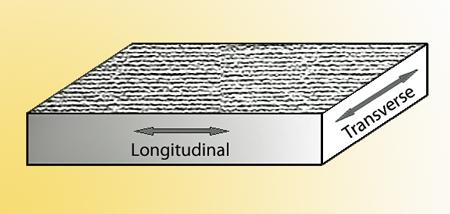
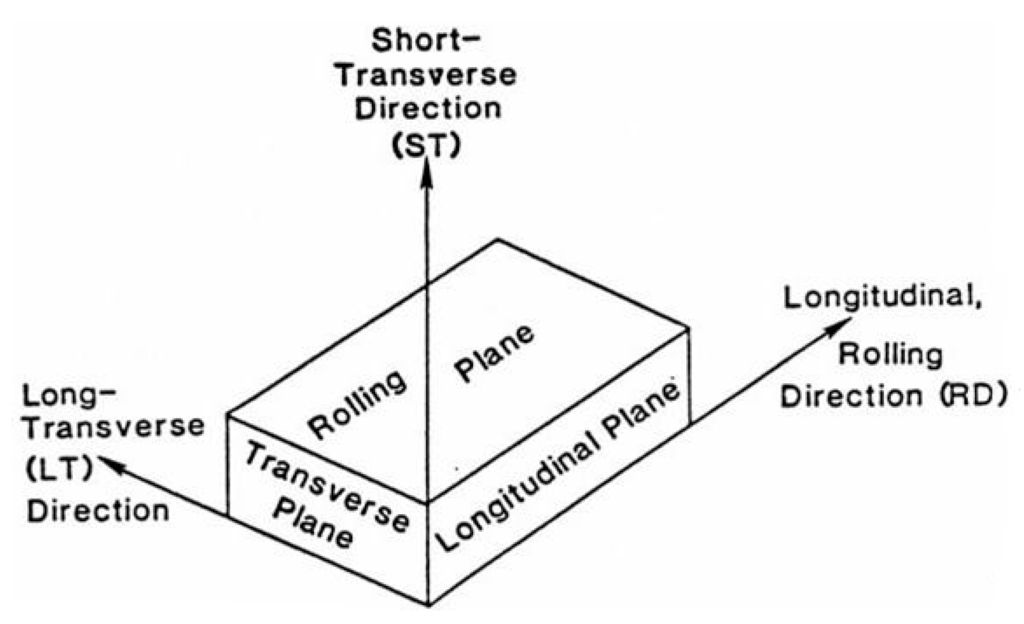
When working with aluminum plate for example you need to pay close attention to whether you are forming with longitudinal or across transverse the grain direction.
Grain direction in sheet aluminum.
The grain direction is in the rolling direction of the sheet as it was being manufactured.
Strength will be the same in all directions.
From the flat pattern properties we can select a new edge for the grain direction.
The crystalline lattice structures form during the cooling of the metal from its molten state and are held together by thin layers of amorphous solid.
Once the crystallites are elongated they appear as the.
Bending with the grain gives a different result than bending against it.
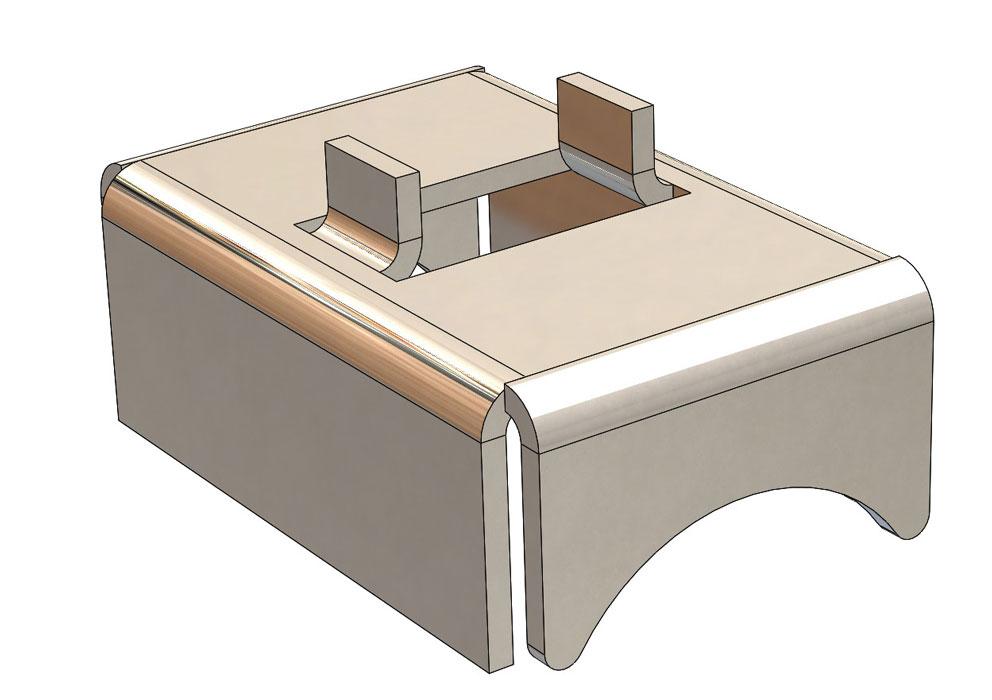
In addition to the new bounding box sketch there is a new option in the property manager for the flat pattern feature.
A plate s grains run parallel to the rolling direction.
These grains vary in size and in orientation but are usually microscopic and directed from processing conditions.
The grain direction is established during the metal rolling process.
You ll now see that your flat pattern is generated based on one edge oriented parallel to the angled edge and the other obviously perpendicular to that in drawing the rectangle.
When sheetmetal is bend perpendicular to rolling direction grain rearranges.
Applying this to metal bending be it plate bending press braking or any other type of metal forming consideration must be given to the grain direction before any process is carried out.
The software determines the smallest rectangle bounding box that aligns with the grain direction to fit the flat pattern.
I m sure that 7075 sheet is made the same as 6061 with grain running lengthwise.
During sheet metal processing rolling operation material grains are arranged in the direction of rolling.
Whereas bending parallel to rolling direction can lead to cracks because of destruction in grain structure.
The grain direction of the metal also contributes to the amount of springback that occurs in a bending operation.
Only concern would be a rough grain can cause a stress riser if not polished out if a bending load is applied perpendicular to the grain.
As a general rule the grain line must run perpendicular to the bend to avoid the potential for cracking or fracture.
That has negligible impact on part strength.
This has to do with the sheet grain direction.
Where does grain direction come from.
You can define a grain direction to use when calculating the bounding box for sheet metal parts.